
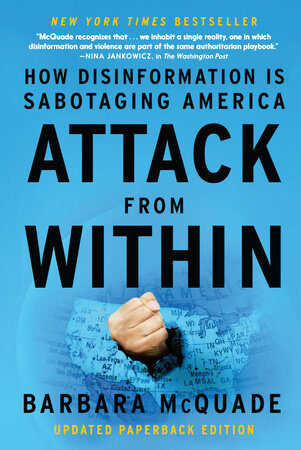
Attack from Within

How Disinformation is Sabotaging America

by Barbara McQuade

Publisher: Penguin Random House

UPDATED EDITION: The MSNBC legal analyst explores the impact of disinformation after the 2024 presidential election—and what Americans can do before it’s too late.

“A comprehensive guide to the dynamics of disinformation and a necessary call to theethical commitment to truth that all democracies require.” —Timothy Snyder, author of On Tyranny

Disinformation—the deliberate spreading of lies disguised as truth, whether from opportunists on the far right, misinformed media influencers, or others—is fragmenting America more than ever before, pushing the nation toward extreme views, civil unrest, and violence.

In this bestselling book, now with a new foreword by the author, Barbara McQuade identifies how disinformation is seeping into all facets of our society, causing havoc in our voting systems, schools, hospitals, workplaces, and the Capitol.

McQuade, an MSNBC legal analyst and former federal prosecutor confronts the ways disinformation is being weaponized to polarize voters, degrade our legal structures, and leverage the political influence of manipulators and authoritarians. Now newly updated, Attack from Within shows us how to fight back against misinformed, extremist thinking and work toward preserving America’s hard-won democracy.

Buy

Thoughts on Aliens of Our Creation

Do they work for us, or for themselves?

By: Bruce Rafnel

Publisher: Substack, Authentic Community

Clearly, humans are causing climate change.

But we have more problems than warming the planet. Even if we control the temperature by reducing our CO2 emissions, there are many other ecological problems caused by humans: deforestation, desertification, disruption of water cycles, plastic pollution, insect decline, fishery collapses, and fuel resource depletion. The list goes on and on. “It is no accident that the ruins of the world’s oldest civilizations are mostly in deserts now. It wasn’t desert before that.”

Our human institutions are unwilling (or unable) to address these problems with real solutions. We created these institutions—corporations and governments, most notably—but we seem unable to control them. They have morphed into alien entities that now control us.

The smallest effective human-powered unit is a community, not an individual. However, tight, effective communities have been hobbled. It is time to relearn how to build communities, and then to do the work of taking back our government. At the same time, large organizations can be reformed or broken up, with non-violent actions, to remind them that they exist for humans, not themselves.

4 tips for developing critical thinking skills

By: Steve Pearlman, Ph.D

Publisher: TEDx Talks, TEDxCapeMay

“Critical thinking” increasingly stands as the most sought-after skill that has long been too fleeting to define. Employers rate it as a pinnacle skill, but one of which they see too little, and educators claim to teach it, but over half of Millennials recently failed a simple Mindedge critical thinking test. So, what is critical thinking? Analysis? Information literacy? Thinking outside the box? Informal logic? Problem-solving? Evaluating data? Decision science? What if all of our efforts to define critical thinking as above have been the core problem with teaching it?

What if, instead of using our brains to devise conceptions of critical thinking, we eliminated the noise and revolutionized a way to teach people how to think better by tracing critical thinking back to its core evolutionary survival mechanisms?

What are the basic survival skills for all organisms?

  1. Perceive their environment
  2. Sense danger vs. reward
  3. Decide between danger and reward
  4. Act on the decision

The Highest Common Denominator

Using Convergent Facilitation to Reach Breakthrough Collaborative Decisions

by Miki Kashtan

Miki introduces a novel decision-making process called Convergent Facilitation that builds trust from the beginning, surfaces concerns and addresses them, and turns conflicts into creative dilemmas that groups feel energized to solve together. This highly effective process has been used successfully around the world to resolve problems and teach people how to collaborate without sacrificing productivity.

Continue reading The Highest Common Denominator