
Keep Your Guard Up

Know Your Rights

By ACLU

Last month, the Bay Area braced for a surge of National Guard soldiers and federal immigration agents. Although Trump ultimately called off the troops, in the short time Border Patrol officers were here, they fired flash-bang grenades at peaceful community members and shot a pastor in the face with a pepper ball. The unprovoked violence was a chilling glimpse of how future immigration raids could unfold here. That’s why we can’t become complacent.

Be prepared and know your rights in case federal agents show up anywhere in our region:

This is from the ACLU’s Know Your Rights page.

The Shadow President

How Russell Vought became Trump's Shadow President

by Andy Kroll

Publisher: ProPublica

From the wholesale gutting of federal agencies to the ongoing government shutdown, Russell Vought has drawn the road map for Trump’s second term. Vought has consolidated power to an extent that insiders say they feel like “he is the commander in chief.”

What Vought has done in the nine months since Trump took office goes much further than slashing foreign aid. Relying on an expansive theory of presidential power and a willingness to test the rule of law, he has frozen vast sums of federal spending, terminated tens of thousands of federal workers and, in a few cases, brought entire agencies to a standstill. In early October, after Senate Democrats refused to vote for a budget resolution without additional health care protections, effectively shutting down the government, Vought became the face of the White House’s response. On the second day of the closure, Trump shared an AI-generated video that depicted his budget director — who, by then, had threatened mass firings across the federal workforce and paused or canceled $26 billion in funding for infrastructure and clean-­energy projects in blue states — as the Grim Reaper of Washington, D.C. “We work for the president of the United States,” a senior agency official who regularly deals with the OMB told me. But right now “it feels like we work for Russ Vought. He has centralized decision-­making power to an extent that he is the commander in chief.”

(Archive)

Watch: “We Want the Bureaucrats to Be Traumatically Affected”

How to Have Constructive Conversations

We must be willing to ‘talk about it’

Everyone in our democracy must be able to speak their minds about public issues. Speaking up needs to be safe, responsible, respectful and free.  This includes airing differences, supplying facts, and explaining opinions and options.   

Even in conversations with people with whom we seem to agree, it’s important to air differences. This can be challenging, yet it’s worth it because we can learn from each other. 

Conversations with others who have very different perspectives, or whose views seem to be underinformed or based on inaccurate information, or different values, can be much harder. 

Basic Guidelines:

  • Be curious and listen to understand.
  • Show respect and suspend judgment. 
  • Note any common ground as well as any differences. 
  • Be authentic and welcome that from others. 
  • Be purposeful and to the point. 
  • Own and guide the conversation. 

How can we effectively navigate these varied circumstances? Here are five suggestions:

  1. It’s good to have a goal. You might want to learn about others’ perspectives and how they came to them.  You might want to express your own views and be taken seriously. It’s best to be civil and constructive. If there’s a downward spiral, it’s OK to take a time out.
  2. Establish a personal connection. Tell stories from your life and ask about theirs; look for common themes.  Ask, “I wonder…?”  or “I’m curious about…”   Note opportunities to bond and connect over shared experiences and interests. You also show respect when you ask: “What am I missing on this topic?  How can I learn something more about this?”
  3. When something you disagree about comes up, you might ask: How did you develop that viewpoint? What is your source of information?  What experiences shape your opinion?  Focus on personal stories and look for areas you have in common.  You might discuss values (e.g., caring, fairness, freedom, equality before the law, honesty).  Or you might explore overlaps in specific situations.  In what circumstances might one value take precedence?  Why?  We have a lot to learn from each other.
  4. Another approach is to get down to brass tacks and ask about democracy. Taking a suggestion from the book, How to Have Impossible Conversations: A Very Practical Guide, by Peter Boghossian and James Lindsay, you might pose a simple poll to them: on a scale of 1 to 10, with one being “I have no concerns about American democracy at all” and 10 being “American democracy is at the most serious risk in its history,” what number would you choose?  Why?  What might cause you to change your mind?  There could be genuine curiosity about their explanations without having to agree with their viewpoints.
  5. Find ways to work together on a project of mutual interest.  Schools? Performing Arts? Open Space? Fire Safety? This can demonstrate that democracy (e.g., disagreeing respectfully, setting rules and establishing fair processes, listening actively, etc.) can help produce wiser, fairer, more lasting, and more efficient outcomes.

Don’t Coerce. Listen First!

Beyond Conflict Institute reports “people perceive that the other side disagrees with them far more than is actually the case.”

So let’s find the courage to

  • GET CURIOUS! 
  • ASK QUESTIONS! 
  • LISTEN TO LEARN!
  • LOOK FOR COMMON GROUND!
  • We can always agree to disagree. 
  • If things get heated, take a break!

Check out these articles for more: 

Are we really as divided as we think? How dark forces are attempting to alienate us from our neighbours, The Toronto Star, April 25, 2023, by Frank Giustra

Yes, It’s Possible to (Gracefully) Talk Politics at Work, Harvard Business Review, October 30, 2020, by Raina Brands

Keeping It Civil: How To Talk Politics Without Letting Things Turn Ugly, NPR, April 12, 2019, by Caroline Kelly

Actor and Zen priest, Peter Coyote, on protest tactics

by Peter Coyote

This Substack post was reformatted and posted on Facebook.

Summary

I’m watching the Los Angeles reaction to ICE raids with trepidation and regret.

Three years ago I taught a class at Harvard on the “theater of protest”— designed to help people understand why so many protests turn out to be Republican campaign videos working directly against the interests of the original protest.

Continue reading Actor and Zen priest, Peter Coyote, on protest tactics

How to Spot Deliberately Misleading -DISINFORMATION

by Indivisible PV

CHECK THE SOURCE

Use reputable sources such as established news organizations, academic institutions, and government agencies. Be wary of sources that are unfamiliar or have a history of spreading false information.

VERIFY THE INFORMATION

Before sharing information, check to see if it has been reported by multiple sources. If not, it may be false or misleading.

LOOK FOR EVIDENCE

Disinformation often lacks evidence or relies on weak or misleading evidence. Look for sources that provide strong evidence to support their claims.

BE SKEPTICAL OF EMOTIONAL APPEALS

Disinformation often uses emotional appeals to manipulate people. Be wary of information that tries to appeal to your emotions rather than your reason.

BE AWARE OF YOUR OWN BIASES

We all have biases that can affect how we interpret information. Be aware of your own biases and try to approach information with an open mind.

THINK CRITICALLY

Ask questions, look for evidence, and consider alternative explanations.

Check Facts @:

White Rural Rage

The Threat to American Democracy

by Tom Schaller and Paul Waldman

Publisher: Random House Trade Paperbacks

In White Rural Rage, Tom Schaller and Paul Waldman explore why rural Whites have failed to reap the benefits from their outsize political power and why, as a result, they are the most likely group to abandon democratic norms and traditions. Their rage—stoked daily by Republican politicians and the conservative media—now poses an existential threat to the United States.

INTERVIEW: Tom Schaller and Paul Waldman talk to Matt Lewis Media

Washington Post – Review

Buy

Thoughts on Aliens of Our Creation

Do they work for us, or for themselves?

By: Bruce Rafnel

Publisher: Substack, Authentic Community

Clearly, humans are causing climate change.

But we have more problems than warming the planet. Even if we control the temperature by reducing our CO2 emissions, there are many other ecological problems caused by humans: deforestation, desertification, disruption of water cycles, plastic pollution, insect decline, fishery collapses, and fuel resource depletion. The list goes on and on. “It is no accident that the ruins of the world’s oldest civilizations are mostly in deserts now. It wasn’t desert before that.”

Our human institutions are unwilling (or unable) to address these problems with real solutions. We created these institutions—corporations and governments, most notably—but we seem unable to control them. They have morphed into alien entities that now control us.

The smallest effective human-powered unit is a community, not an individual. However, tight, effective communities have been hobbled. It is time to relearn how to build communities, and then to do the work of taking back our government. At the same time, large organizations can be reformed or broken up, with non-violent actions, to remind them that they exist for humans, not themselves.
In Trump’s Alternate Reality, Lies and Distortions Drive Change

Condoms for Gaza? Ukraine started the war with Russia? The president’s manipulations of the truth lay the groundwork for radical change.

by Peter Baker

Publisher: The New York Times

Mr. Trump has long been unfettered by truth when it comes to boasting about his record and tearing down his enemies. But what were dubbed “alternative facts” in his first term have quickly become a whole alternative reality in his second to lay the groundwork for radical change as he moves to aggressively reshape America and the world.

Read Article

How to Organize Our Way Out of the Trump-Musk Putsch

A plan to harness grassroots energy—and to hold Democratic leaders accountable.

by Ezra Levin, Leah Greenberg

Summary

Indivisible founders, Ezra Levin and Leah Greenberg, wrote this inspiring article for The Nation. Reviewed by Rachael Maddow.

Continue reading How to Organize Our Way Out of the Trump-Musk Putsch

Photographic Evidence is Dead

Fake Image, Fake NEWS, Fake Trust.

By: Turtle Engineer (AKA: Bruce Rafnel)

Publisher: Medium, Slow Engineering

We have now witnessed the death of almost 200 years of photographic (and other recorded) evidence. Images, videos, and audio recordings can now be easily faked or altered in ways that cannot be detected. Digital technology has made this happen. Analog media is continuous, so subtle modifications can be noticed. However, digital media has discrete bits that are not dependent on the bits around them.

It is time to relearn what was so obvious to our ancestors: the SOURCE is more important than the content. “Do you trust or believe the source?” This can be a personal choice, but we no longer have the convenience of “socially accepted” sources.

Some technologies can “help” build trust, but they can all be compromised. We should never again put unconditional trust in any medium or technology.

Indivisible: A Practical Guide To Democracy On The Brink

If there’s one universally accepted truth in the modern age, it’s that sequels suck. And Trump 2.0 will be no exception. Trump, Vance, and their MAGA minions feel vindicated by the victory of their bigoted, fascistic clown show of a presidential campaign. Trump takes office with a plan to institute the worst parts of Project 2025. He’ll be enabled by a judiciary packed with right-wing ideologues and a congressional majority stacked with MAGA foot soldiers. And he’s assembled a bloc of corporations and billionaires eager to do his bidding in exchange for tax cuts and corrupt favors. But he has no mandate for the staggeringly harmful agenda he’s about to unleash on the country. And together, we have the power to fight back — and win.

Resource GuideArchive

Is the press trying to help elect Trump?

Trump loses again, as Biden is cleared

By: L O L G O P

Frame Lab advises responding to the special council report of Biden’s classified documents investigation by pointing out that Biden was cleared while Trump is still facing indictments. 

“The best way for the media to sell newspapers and clicks is to give Republicans what they want to hear, which drives liberals to hate reading, hate sharing, and even hate subscribing.  By rebutting them, [we] spread and strengthen them. That’s how our brains work.” 

Always ‘Reframe’ Republican Talking Points

NEVER REPEAT LANGUAGE REPUBLICANS USE

“Consider the phrase “tax relief.” The world “relief” frames the word “tax” as an affliction or form of suffering. We generally need “relief” from things that are painful or unpleasant…Another example: Consider the phrase “forced birth.” It frames abortion bans with a negative word, “forced,” which frames abortion bans as aggressively stripping women of their freedom.”  Moral Warfare 101: Frames and Your Brain, Frame Lab, February 5, 2024 

“…when environmental issues are reframed in terms of the conservative value of purity – emphasizing the importance of keeping our forests, drinking water, and skies pure – conservatives are much more likely to support this cause.  

The power of framing: It’s not what you say, it’s how you say it

The Guardian, July 20, 2017

Climate change? Global warming?

“David Fenton, a longtime PR specialist for progressive causes…urges the climate community to speak of pollution – a word everyone gets – and to settle on the image of a ‘blanket of pollution trapping heat on Earth’. Every oil and gas emission makes that blanket thicker – and all that trapped heat helps cause floods and start fires, he says.” As heat records break, the climate movement has the right answers – but the words are all wrong The Guardian, July 14, 2023

Frame Lab explains:

“Much of politics is a struggle to define how certain key words are framed — words like ‘tax,’ ‘freedom,’ ‘rights’ and ‘truth.’ 

“If you oppose an issue, you must try to frame it in negative terms. If you support an issue, you must try to frame it positively.”

Cognitive scientist Dr. George Lakoff and journalist Gil Duran share their political messaging expertise at  

Frame Lab on Substack.

Latest Frame Lab Articles

Yes, Republicans really believe in starving kids

By: L O L G O P

Republican governors in 15 red states have refused to participate in this summer’s federal free lunch program, denying food to approximately 8 million kids. 

Frame Lab advises responding without mentioning welfare states or calling Republicans scrooges. Say instead,  “Tate Reeves [Republican Governor of Mississippi] doesn’t want these kids to succeed. He doesn’t want them to have the same freedom as his kids enjoy. This isn’t just about punishing poor kids for being poor. It’s about taking away their opportunities.”

A Warning About Donald Trump and 2024

by The Editorial Board (New York Times)

Summary

“Mr. Trump does not offer voters anything resembling a normal option of Republican or Democrat, conservative or liberal, big government or small. He confronts America with a far more fateful choice: between the continuance of the United States as a nation dedicated to “the blessings of liberty to ourselves and our posterity” and a man who has proudly shown open disdain for the law and the protections and ideals of the Constitution.”

Publisher: The New York Times

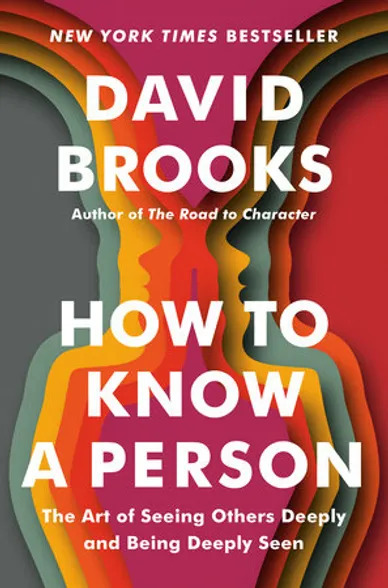
How to Know a Person

The Art of Seeing Others Deeply and Being Deeply Seen

by David Brooks

Summary

Recommended by Bob

Driven by his trademark sense of curiosity and his determination to grow as a person, David Brooks draws from the fields of psychology and neuroscience and from the worlds of theater, philosophy, history, and education to present a welcoming, hopeful, integrated approach to human connection. How to Know a Person helps readers become more understanding and considerate toward others, and to find the joy that comes from being seen. Along the way it offers a possible remedy for a society that is riven by fragmentation, hostility, and misperception.

Continue reading How to Know a Person

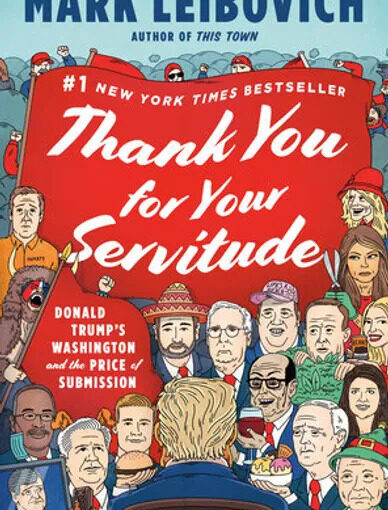
Thank You for Your Servitude

Donald Trump’s Washington and the Price of Submission
By Mark Leibovich
Publisher: Penguin Press

Recommended by Cindi

“This is a really funny book.” Kara Swisher. 

Mark Leibovich’s unflinching account of the moral rout of a major American political party, tracking the transformation of Rubio, Cruz, Graham, and their ilk into the administration’s chief enablers, and the swamp’s lesser lights into frantic chasers of the grift…isn’t another view from the Oval Office: it’s the view from the Trump Hotel. 

The Art & Science of Persuasion Playbook

A Message from Galvanize Action about a huge block of persuadable voters!

“White women are the largest voting bloc in this country and will be for decades to come. They account for 38% of the national vote share and 43% of the vote share across Galvanize Action’s priority states. Within this voting bloc, we’ve identified 44,093,812 moderate women who are not ideologically entrenched, meaning they are open to new ideas and perspectives and movable on key issues such as reproductive freedom, healthcare, gender equity, climate, and the economy.”

Galvanize Action has a fabulous interactive messaging worksheet we can all use!

Galvanize Action says, “We’ll share with you exactly how to create a message that meets people at their values and how to turn those into an effective ad. Our interactive worksheet will guide you through the process with prompts about your target audience and the issue you want to move them on. You’ll walk away with customized advice!”

The Election Sabotage Scheme and How Congress Can Stop It

The Freedom to Vote Act can halt this growing antidemocratic threat.

by Will Wilder, Derek Tisler, Wendy R. Weiser

Publisher: Brennan Center for Justice

Essentially this article addresses laws and proposed legislation enabling partisan interference in election administration as part of a broader “election sabotage” or “election subversion” campaign, a national push to enable partisans to distort democratic outcomes.

Read Article

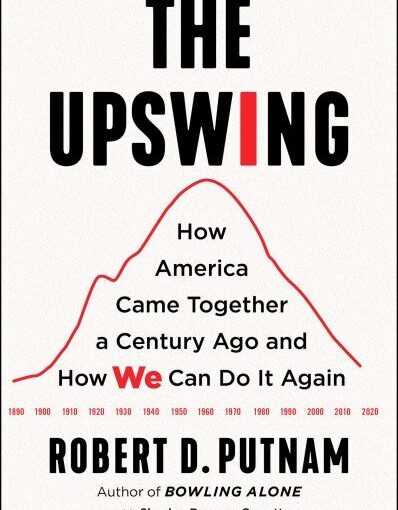
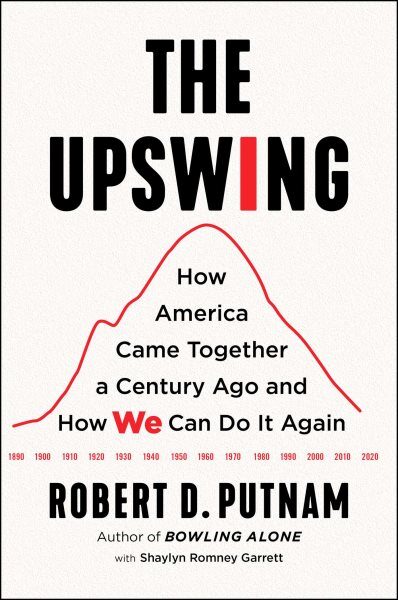
The Upswing

how America came together a century ago and how we can do it again

by Robert D. Putnam and Shaylyn Romney Garrett.

Publisher: Simon & Schuster

“An eminent political scientist’s brilliant synthesis of social and political trends over the past century that shows how we have gone from an individualistic society to a more communitarian society and then back again — and how we can use that experience to overcome once again the individualism that currently weakens our country”

We can’t go back to when things were “good.” But we can learn from when things ware “bad.” In the early 1900’s the Guilded Age of the robber barons, things were really bad for most US citizens; they feared for the end of democracy and the take-over by the oligarchs.

Buy

Interview: Robert Putnam Knows Why You’re Lonely


The 2023 Ithiel de Sola Pool Lecture by Robert D. Putnam
Sep 22, 2023


Join or Die — Trailer (2023)

The Documentary “Join or Die” (2023) is currently available on Netflix (2025-08-11)

It Was All a Lie

How The Republican Party Became Donald Trump

by Stuart Stevens

Publisher: Knopf

Recommended by: Cindi S. and Steve G.

Written by Republican political consultant Stuart Stevens, this is a tell-all book about how the party he’s stood with for years spiraled out of control and lost the moral and political standpoints that once made it great. Unlike other books about Donald Trump, Stevens presents the 45th president of the United States as the inevitable result of the Republican Party’s failings, not its instigator.

Stuart Stevens spent decades electing Republicans at every level, from presidents to senators to local officials. He knows the GOP as intimately as anyone in America, and in this new book he offers a devastating portrait of a party that has lost its moral and political compass.

This is not a book about how Donald J. Trump hijacked the Republican Party and changed it into something else. Stevens shows how Trump is in fact the natural outcome of five decades of hypocrisy and self-delusion, dating all the way back to the civil rights legislation of the early 1960s. Stevens shows how racism has always lurked in the modern GOP’s DNA, from Goldwater’s opposition to desegregation to Ronald Reagan’s welfare queens and states’ rights rhetoric. He gives an insider’s account of the rank hypocrisy of the party’s claims to embody “family values,” and shows how the party’s vaunted commitment to fiscal responsibility has been a charade since the 1980s. When a party stands for nothing, he argues, it is only natural that it will be taken over by the loudest and angriest voices in the room.

It Was All a Lie is not just an indictment of the Republican Party, but a candid and often lacerating mea culpa. Stevens is not asking for pity or forgiveness; he is simply telling us what he has seen firsthand. He helped to create the modern party that kneels before a morally bankrupt con man and now he wants nothing more than to see what it has become burned to the ground.

Read Review

Buy

Strategizing For A Living Revolution

by George Lakey

Publisher: History As A Weapon

Recommended by: Bruce R.

This article is a comprehensive strategic framework for nonviolent revolution, combining historical case studies, practical organizing guidance, and theoretical insights about movement building.

Read Article

Archive

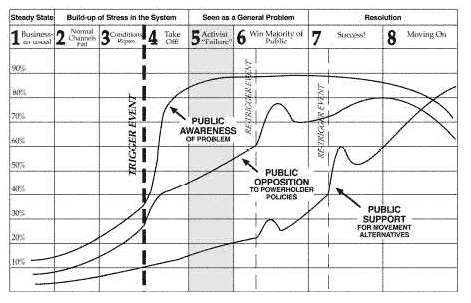
The Movement Action Plan

A Strategic Framework Describing The Eight Stages of Successful Social Movements

by Bill Moyer

Publisher: History Is A Weapon

Recommended by: BruceR

Within a few years after achieving the goals of “take-off”, every major social movement of the past twenty years has undergone a significant collapse, in which activists believed that their movements had failed, the power institutions were too powerful, and their own efforts were futile. This has happened even when movements were actually progressing reasonably well along the normal path taken by past successful movements!

The Movement Action Plan (MAP) was first published as the Fall 1986 edition of the Dandelion. Twelve-thousand copies were published and distributed. This is a revised edition of that article. People are invited to participate in the continuing development of MAP and help spread it to local groups.

Read Article

Archive