
How To Not Lose Your Sh!t

by Katie Paris and LaFonda Cousin

Publisher: Red Wine and Blue

Let’s be honest: this year has been a bit of a dumpster fire. Here at Red Wine & Blue, we’ve been hearing women in our community say they’re not sure how to make a difference — at least, not without totally losing their shit.

So we decided to tackle that question head-on with a brand-new podcast. It’s simply called How To Not Lose Your Sh!t and it’s hosted by our very own Katie Paris and LaFonda Cousin.

Katie, our founder, has worked in political organizing for most of her career. LaFonda, our Chief People Officer, is a wellness expert and yoga teacher on a mission to reimagine self-care. Every week, they’ll talk to experts and everyday women who are getting involved, building community, and feeling better in the process.

You can listen to our first episode with special guest Heather Cox Richardson on October 1st, with new episodes every Wednesday after that. If you’re already subscribed to the Red Wine & Blue podcast in your podcast player, you’ll automatically see new episodes each week here in your feed.

There are a lot of political podcasts out there already, and a lot of mental health and self-care shows too. What we want to do is reject that binary and explore how getting involved can actually be a form of not only caring for your community, but also yourself. We can’t wait for you to join us on a journey through self-care, politics, community, and tackling this difficult moment… together.


The ONE THING You Can Do to Fight Fascism RIGHT NOW

by Elizabeth Cronise McLaughlin

Publisher: The Ripple Effect Institute

Recommended by: Bruce R.

If it feels like America is sliding deeper into darkness—with voter suppression, book bans, gag orders, and fear spreading daily—you’re not alone. The truth is, fascism thrives when good people hesitate, but democracy grows stronger when ordinary people take action. You don’t need the full roadmap to change the world; you just need to take the next best step. Even the smallest action—whether it’s organizing in your community, speaking out at a school board meeting, or showing up for your neighbors—can disrupt authoritarianism and build momentum for lasting change. In this video, I’ll share why action is the antidote to despair and how you can start making a difference today, no matter your resources or time. History shows us that small acts, multiplied by thousands, topple regimes and create movements. Don’t wait for the “perfect” moment or the “perfect” leader—your courage matters now.

A FREE GUIDE FOR PROGRESSIVE LEADERS READY TO CREATE LASTING IMPACT

How to Lead Change Without Burning Out

READ MY ESSAYS ON POLITICS AND ACTIVISM ON SUBSTACK

One Million Rising

by Indivisible

Publisher: No Kings

Across the country, authoritarian forces are getting bolder and more dangerous. Trump and his allies are not hiding their agenda: mass deportations, rollbacks of civil rights, weaponized courts, and full-scale attacks on our democracy. We don’t have to wait until it’s too late. We can stop this. But it’ll take all of us—not just single days of mass action, but sustained organizing in our communities.

That’s why this summer, we’re launching One Million Rising—a national effort to train one million people in the strategic logic and practice of non-cooperation, as well as the basics of community organizing and campaign design. This is how we build people power that can’t be ignored. You’re invited to join us—and lead.

You can visit the site to see the recorded videos and access the training materials.

https://www.nokings.org/rise

Thoughts on Aliens of Our Creation

Do they work for us, or for themselves?

By: Bruce Rafnel

Publisher: Substack, Authentic Community

Clearly, humans are causing climate change.

But we have more problems than warming the planet. Even if we control the temperature by reducing our CO2 emissions, there are many other ecological problems caused by humans: deforestation, desertification, disruption of water cycles, plastic pollution, insect decline, fishery collapses, and fuel resource depletion. The list goes on and on. “It is no accident that the ruins of the world’s oldest civilizations are mostly in deserts now. It wasn’t desert before that.”

Our human institutions are unwilling (or unable) to address these problems with real solutions. We created these institutions—corporations and governments, most notably—but we seem unable to control them. They have morphed into alien entities that now control us.

The smallest effective human-powered unit is a community, not an individual. However, tight, effective communities have been hobbled. It is time to relearn how to build communities, and then to do the work of taking back our government. At the same time, large organizations can be reformed or broken up, with non-violent actions, to remind them that they exist for humans, not themselves.


Authentic Community feed

Of Men and Boys

Why the Modern Male Is Struggling, Why It Matters, and What to Do about It

by Richard V. Reeves

Publisher: Brookings Institution Press

Recommended by: Bob B.

“The problem with men is typically framed as a problem of men,” writes Reeves. “It is men who must be fixed, one man or boy at a time. This individualist approach is wrong.” Instead, he maintains there are structural problems, societal issues, that need to be addressed if men are not to become ever more lost, defeated and angry.

Review

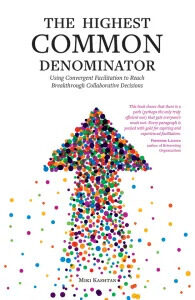
The Highest Common Denominator

Using Convergent Facilitation to Reach Breakthrough Collaborative Decisions

by Miki Kashtan

Miki introduces a novel decision-making process called Convergent Facilitation that builds trust from the beginning, surfaces concerns and addresses them, and turns conflicts into creative dilemmas that groups feel energized to solve together. This highly effective process has been used successfully around the world to resolve problems and teach people how to collaborate without sacrificing productivity.

Continue reading The Highest Common Denominator

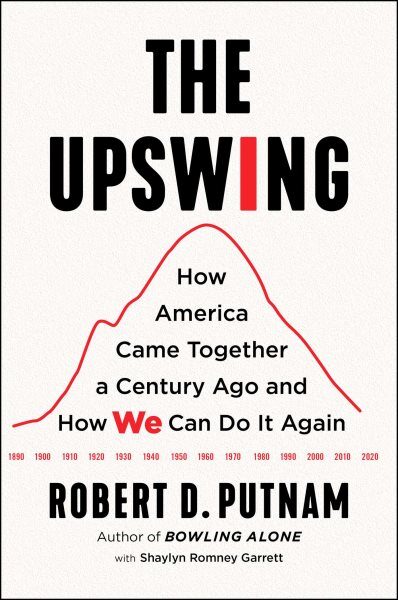
The Upswing

how America came together a century ago and how we can do it again

by Robert D. Putnam and Shaylyn Romney Garrett.

Publisher: Simon & Schuster

“An eminent political scientist’s brilliant synthesis of social and political trends over the past century that shows how we have gone from an individualistic society to a more communitarian society and then back again — and how we can use that experience to overcome once again the individualism that currently weakens our country”

We can’t go back to when things were “good.” But we can learn from when things ware “bad.” In the early 1900’s the Guilded Age of the robber barons, things were really bad for most US citizens; they feared for the end of democracy and the take-over by the oligarchs.

Buy

Interview: Robert Putnam Knows Why You’re Lonely


The 2023 Ithiel de Sola Pool Lecture by Robert D. Putnam
Sep 22, 2023


Join or Die — Trailer (2023)

The Documentary “Join or Die” (2023) is currently available on Netflix (2025-08-11)

Strategizing For A Living Revolution

by George Lakey

Publisher: History As A Weapon

Recommended by: Bruce R.

This article is a comprehensive strategic framework for nonviolent revolution, combining historical case studies, practical organizing guidance, and theoretical insights about movement building.

Read Article

Archive

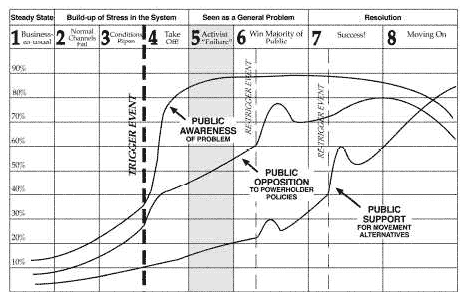
The Movement Action Plan

A Strategic Framework Describing The Eight Stages of Successful Social Movements

by Bill Moyer

Publisher: History Is A Weapon

Recommended by: BruceR

Within a few years after achieving the goals of “take-off”, every major social movement of the past twenty years has undergone a significant collapse, in which activists believed that their movements had failed, the power institutions were too powerful, and their own efforts were futile. This has happened even when movements were actually progressing reasonably well along the normal path taken by past successful movements!

The Movement Action Plan (MAP) was first published as the Fall 1986 edition of the Dandelion. Twelve-thousand copies were published and distributed. This is a revised edition of that article. People are invited to participate in the continuing development of MAP and help spread it to local groups.

Read Article

Archive