
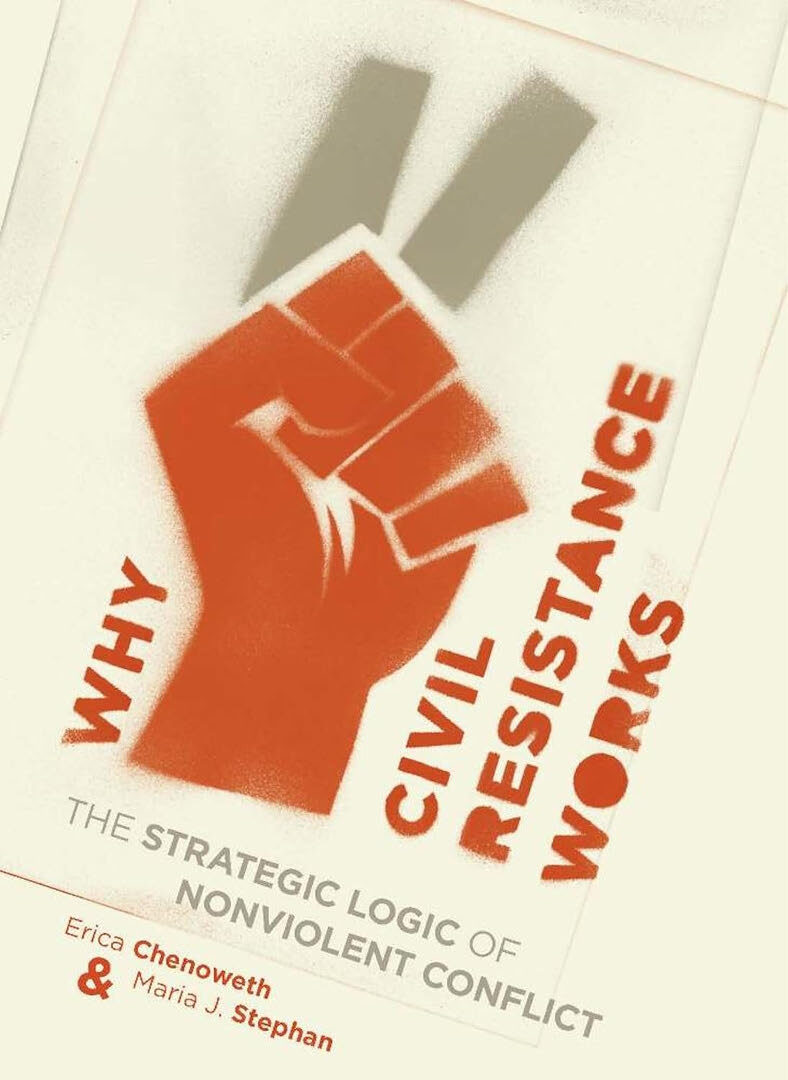
Why Civil Resistance Works

The Strategic Logic of Nonviolent Conflict

by Erica Chenoweth and Maria Stephan

Publisher: Columbia University Press

For more than a century, from 1900 to 2006, campaigns of nonviolent resistance were more than twice as effective as their violent counterparts in achieving their stated goals. By attracting impressive support from citizens, whose activism takes the form of protests, boycotts, civil disobedience, and other forms of nonviolent noncooperation, these efforts help separate regimes from their main sources of power and produce remarkable results, even in Iran, Burma, the Philippines, and the Palestinian Territories.

Combining statistical analysis with case studies of specific countries and territories, Erica Chenoweth and Maria J. Stephan detail the factors enabling such campaigns to succeed and, sometimes, causing them to fail. They find that nonviolent resistance presents fewer obstacles to moral and physical involvement and commitment, and that higher levels of participation contribute to enhanced resilience, greater opportunities for tactical innovation and civic disruption (and therefore less incentive for a regime to maintain its status quo), and shifts in loyalty among opponents’ erstwhile supporters, including members of the military establishment.

Buy

Strategizing For A Living Revolution

by George Lakey

Publisher: History As A Weapon

Recommended by: Bruce R.

This article is a comprehensive strategic framework for nonviolent revolution, combining historical case studies, practical organizing guidance, and theoretical insights about movement building.

Read Article

Archive

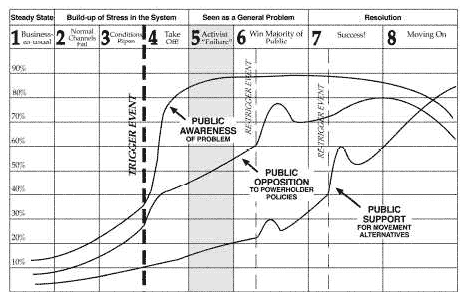
The Movement Action Plan

A Strategic Framework Describing The Eight Stages of Successful Social Movements

by Bill Moyer

Publisher: History Is A Weapon

Recommended by: BruceR

Within a few years after achieving the goals of “take-off”, every major social movement of the past twenty years has undergone a significant collapse, in which activists believed that their movements had failed, the power institutions were too powerful, and their own efforts were futile. This has happened even when movements were actually progressing reasonably well along the normal path taken by past successful movements!

The Movement Action Plan (MAP) was first published as the Fall 1986 edition of the Dandelion. Twelve-thousand copies were published and distributed. This is a revised edition of that article. People are invited to participate in the continuing development of MAP and help spread it to local groups.

Read Article

Archive